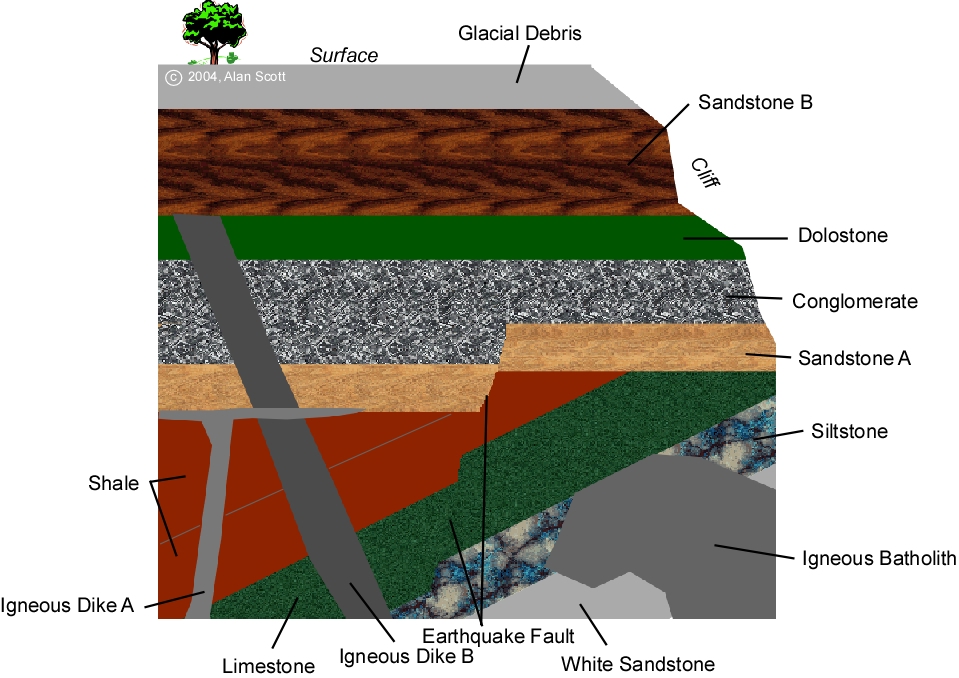
The term rock is used for those materials of many kinds which form the greater part of the relatively thin outer shell, or crust, of the Earth; some are comparatively soft and easily deformed and others are hard and rigid. They are accessible for observation at the surface and in mines and borings. Three broad rock groups are distinguished, on the basis of their origins rather than their composition or strength:
Igneous Rocks
Igneous rocks, derived from hot material that originated below the Earth's surface and solidified at or near
the surface (e.g. basalt, granite, and their derivatives).
the surface (e.g. basalt, granite, and their derivatives).


Sedimentary Rocks
Sedimentary rocks, mainly formed from the breakdown products of older rocks, the fragments having been
sorted by water or wind and built up into deposits of sediment (e.g. sandstone, shale); some rocks in this group have been formed by chemical deposition (e.g. some limestones). The remains of organisms such as marine shells or parts of plants that once lived in the waters and on the land where sediment accumulated, can be found as fossils.


Metamorphic Rocks
Metamorphic rocks, derived from earlier igneous or sedimentary rocks, but transformed from their original
state by heat or pressure, so as to acquire conspicuous new characteristics (e.g. slate, schist, gneiss).